Tuesday, August 31, 2010

The Aloha Quilt by Jennifer Chiaverini

I first discovered Jennifer Chiaverini by sheer chance. I stood in the bookstore looking for a book by Tracy Chevalier and was attracted by the cover of a nearby book, The Quilter's Apprentice. I am not a quilter but at the time I worked with a volunteer quilting group and I enjoyed watching them work and listening to them talk. I read the first three books in the Elm Creek Quilt series and happily shared the series with my mom and the quilters. The books were easy reads, somewhat sweet, but also informative about the art of quilting.

As Chiaverini grew in renown, her books also grew in number. When I picked up The Aloha Quilt I was surprised to learn it is the 16th book in the series!! And it is one of the better ones I have read lately, honestly. Chiavernini's books fall into two categories: contemporary stories about modern day quilters and their socio-personal interactions versus historical stories about the roles quilts have had in important American historical events. While the historical books are very informative, they just don't grab my attention the same way as the contemporary stories do.

When I saw The Aloha Quilt sitting on the new book shelf at the library I picked it up gleefully and immediately began devouring it. It took me less than two days to read (which is not an amazing feat unless you consider it was the last week of summer and both of my kids were at home pestering me and expecting me to help them get ready for school).

The book takes a secondary character from early Elm Creek novels, Bonnie, and gives her a whole book. Bonnie and her husband have recently filed for divorce (a topic explored in another book) and as a way to escape the ensuing difficulties she moves to Hawaii for six months to help her friend Claire set up a quilt retreat. The story revolves not only around Bonnie, Claire, and the questions over divorce later in life, but also spends a good amount of time on Hawaiian culture.

I found Chiaverini's descriptions of Hawaiian quilting and its offshoot history really interesting. She managed to dovetail the state's unique history with detailed information about the applique-style quilting of the region. Knowing only the most tangential information about Hawaii, I enjoyed learning more in the light style Chiaverini has.

Was the book a bit cliché? Yeah, a bit. Did everything work out in the end with a nice ribbon tied around it? Yes. But that's part of why I like the contemporary Elm Creek stories. They're easy on the psyche. All in all, a great end of the summer read.

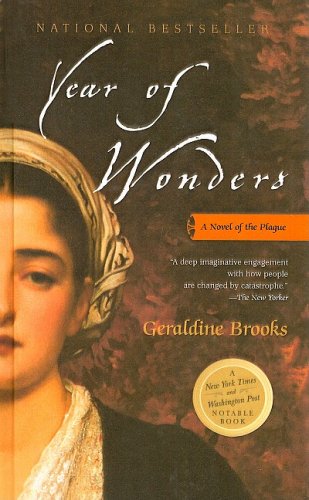
Year of Wonders by Geraldine Brooks

I came at reading Geraldine Brooks in rather a backwards fashion. I started with March, followed by People of the Book and am only now getting to Year of Wonders, Brooks’ first novel. The friend who recommended it described the story as “a book about the plague with some romance thrown in.” With that description in mind, I expected more romance than delivered. Not that less romance is a bad thing, I was just surprised at the outcome of the story.


Backing up, the plot of Year of Wonders revolves around a small northern English town that isolates itself during an outbreak of the Plague to avoid spreading it to neighboring communities. As surprising as it sounds, the story emerged from an actual historical account of an early modern town which did exactly that. The protagonist of the story is the rector’s housekeeper, Anna Frith. The reader learns in the first few pages that she and the rector, Michael Mompellion, are two of the survivors of the attack who remain in the, physically and emotionally, diminished village. Most of the story backtracks and follows the characters through the year of disease, eventually coming full circle so the story meets where it left off at the beginning.


In the Afterward Brooks describes her transition from journalist to novelist, fascinated by understanding the story of the historical Derbyshire village. Brooks’ research skills shine through as her descriptions of the lifestyle and times are apt. At times her graphic imagery leaves too little to the imagination, but given the subject matter it is not surprising. Brooks does acknowledge her choice of a strong female character who sits outside the bounds of traditional society as her focus. In Brooks’ mind the story needed someone who could break the confines of social norms and was in an ability to do so.


I could see common interests in Brooks’ three novels; her work focuses on strong female leads. She takes these characters and places them in nearly impossible (yet historically real) situations to unearth how their strengths allow them to persevere. I enjoy her plots but mostly her development of the issue of integrity.


Year of Wonders reminded me of reading Connie Willis’ The Doomsday Book. The comparison is obvious considering they both focus on the Plague. But the similarities are not merely that straight forward. Like Brooks, Willis writes about the strength and wherewithal to survive adversity and horrible odds. If you haven’t read Year of Wonders and don’t mind descriptive imagery of the Plague, this is a book worth reading. If you’re not so into the Plague, I would still recommend Geraldine Brooks – one of her other stories may be more palatable.

Friday, August 27, 2010

The Abyssinian Proof by Jenny White

Jenny White's first novel in the Kamil Pasha series, The Sultan's Seal, was far and away one of my favorite books this year. White has the uncanny ability of imparting a ton of knowledge about the Ottoman Empire, a subject of which she is well versed, without lecturing or falling into a litany of facts. The plot remains the most important aspect of the book.


The Abyssinian Proof, White's second entry in the nineteenth-century mystery series, tells a nuanced story of a little-known religious group living in the middle of Ottoman Istanbul. The information White has at hand about this leftover Byzantine Christian sect is fascinating. There was a tenuous moment when the story veered into a mention of Templars and I feared White had fallen into the trap of writing another derivative Christianity gone bad novel, à la Dan Brown. But, she saved herself and didn't go there. Thank goodness.


It is easy to lose oneself in White’s novels. She tells a compelling story with plenty of interesting twists and intrigues to keep me reading. The mystery is not overly straight-forward but she does throw in clues throughout to keep me guessing. However, White is also knows her history. She is not writing about stereotypes and overused characteristics of the Ottoman Empire. Her depth of knowledge allows me to learn relevant, genuine historical information within the scope of a fictional story.


Moreover, White tends to throw in some subtle social commentary about our own world. The intrigue between the Christians, the Muslims, and the Jews; the distrust of differing religious beliefs; the debate over political and cultural power based on ethnicity all ring as remarkably true today as they did 150 years ago. White manages to point out that the Ottoman Muslims were not some evil religious offshoot with nothing but bloodlust in their hearts. Her characters are somewhat universal.


I look to disappear into my books. But I don’t mind learning something along the way. Jenny White is one of the best current authors who allows me to do both of those things at the same time. I will definitely be keeping my eyes open for the third book in the series. (Oh, and I heard a rumor she may attempt to discuss the Armenian Genocide in a future story. That would capture plenty of attention.)

Saturday, August 21, 2010

The Russian Concubine by Kate Furnivall

I picked up The Russian Concubine at a discount bookstore based purely on the blurb on the back. A story about White Russians living in Junchow, China in 1928 sounded like a great locale and population for a novel. After a grad school classmate wrote a paper about Russians in China I became intrigued by an ex-pat community I had never heard about before. This book fit that niche perfectly making it a great opportunity for a summer read.

The Russian Concubine was good, but it could have been better. I really enjoyed exactly what I had hoped for - the locale and the interaction between vastly different communities of inhabitants. However, Furnivall fell into too much romance and the plot fell flat by the end of the story. The story revolves around Lydia Ivanova, a young Russian whose father was killed by the Communists when they were fleeing Russia in 1917. The story picks up in 1928 with Lydia pickpocketing a British gentleman and bringing the money back to her drunken, beautiful, classical piano playing mother. Finding herself trapped by dangerous locals, an exotic stranger saves her - enter the love interest: Chang An Lo.

Furnivall's strength lies in her ability to describe the interaction between the various ethnic communities living in China in the interwar era. The British have the money and the power. The Chinese are in the midst of a Civil War between Chang Kai Shek - supported by the British, and the Communists (pre-Mao and a strong leadership). The Russians, meanwhile, exist in a vacuum without either passports, wealth, or power. Lydia and her mother work to give themselves a legitimacy in the society to which they do not belong. The mother uses her beauty to gain financial and social support from better-off men, the daughter uses her wits to manipulate the society to help her.

While I immersed myself in Furnivall's world the story drug in the second half. She spent too much time laboring over the romantic relationship between Lydia and Chang An Lo. Lydia manages to find and save her love in a highly unrealistic way. At the last moment Furnivall throws in a curve ball which I found highly unnecessary and likewise unlikely.

The Russian Concubine was a good summer read; it was diverting and romantic. But I had hopes of reading a more historically-driven accurate story which it was not.

Friday, July 23, 2010

Every Last One by Anna Quindlen

Anna Quindlen is my hero. She has an incredible ability to vividly yet succinctly describe a scene. Reading her prose is effortless; I never feel like I am wading through unnecessary text, yet I can perfectly envision the world she narrates. Honestly, I have read almost none of Quindlen's more well-known column writing, but I have read every novel she has written so I couldn't wait to get my hands on Every Last One. I finished it yesterday and sat thinking, "Wow."

If you have never read any of Quindlen's fiction, be forewarned. Her books are heavy! And emotional. I cry more reading her than almost any other author. Yet, I respect the dilemmas Quindlen forces her characters to face much more than other author's emotive problem-driven plots (think Jodi Picoult). For me, Quindlen doesn't force a particular emotional response on her readers. Her characters are flawed and human rather than idealistic or purely bad. She doesn't tell a reader how they should respond to a situation; instead she presents the situation and allows the reader to decide how they feel about what happened. Moreover, Quindlen doesn't give away the plot on the dust jacket. I will say, the crisis in Every Last One caught me off-guard. I was completely blind-sided by the events that unfolded in the story. At 3 am I lay in bed sobbing with the main character.

Without giving away too much of the plot, the story of Every Last One revolves around a normal all-American family: a doctor father, a part-time working mother, a 17-year old daughter thinking about college, and twin 15-year old brothers one who plays soccer and the other who plays the drums. The daughter breaks up with her long-term boyfriend, the drum-playing son suffers from depression, the mom ponders her childrens' futures. The reality of Quindlen's characters is what gives her book power. We can all imagine ourselves or our neighbors in Quindlen's fictional family. The realism is what gives the tragedy even greater weight.

I would not recommend reading Every Last One at the beach, or anywhere else in public. But I strongly recommend reading it. It really makes you think.

Tuesday, July 20, 2010

Rose Daughter by Robin McKinley

Once upon a time a book-loving sixth grader met a generous intelligent librarian. This librarian, wise in the ways of tween girls, introduced our heroine to the world of fantasy books. Recognizing the dreams of young girls to be princesses and marry princes the librarian offered the young girl Robin McKinley’s books, in particular The Hero and the Crown.


Across the miles and years a tween boy entered the realm of fantasy reading the classic tale of Robin Hood as retold by Robin McKinley in The Outlaws of Sherwood.


Time passed, the two met and shared a love of good fantasy, Robin McKinley having faded into the background of other authors and works. Until the day when our heroine brought home Rose Daughter thrilled to read a new book by the person who introduced her to fantasy. Her husband (and very own prince) saw the book at home and exclaimed, “I remember Robin McKinley. She was …” and our heroine, older, wiser, and no longer desiring the life of a princess finished his sentence, “…one of the first fantasy authors I ever read.” And so ends our story…


Yes, I’m a cheeseball. But yes, it’s true. Both my hubby and I first delved into fantasy reading Robin McKinley’s books. She is the idyllic fantasy author for tween readers. Her stories offer romance and adventure and magic but they are innocent and appealing. Many of her works are retellings of famous fairy tales and Rose Daughter is no exception. As a matter of fact it is the second book by McKinley to retell the story of Beauty and the Beast (the first being her well-loved and recognized Beauty.)


In Rose Daughter McKinley works all the details of the infamous story of Beauty and the Beast into a nuanced version which focuses around the importance of the rose. In this version Beauty is one of three daughters, her special talent being gardening. When she travels to the Beast’s palace she focuses on bringing his rose garden, housed in a large greenhouse, back to life.


The story was intimately familiar but yet novel enough to not be boring. Robin McKinley has an incredibly vivid descriptive writing style without laboring over too many details. All in all, Rose Daughter reminded me of my introduction to the world of good, innocent (romantic) fantasy. A great light summer read.

Thursday, July 15, 2010

Prep by Curtis Sittenfeld

Prep satisfied everything that the last two books I read have not satisfied. I thoroughly enjoyed reading it, even if it wasn't exactly what I thought it would be.


My husband noticed me reading a new book the other night and asked what I was reading. Based on the quotes on the cover I replied, "A female version of A Separate Peace.” My answer was largely tongue-in-cheek but having finished the book, it was actually an extremely apt description. Prep is the story of a fish-out-of-water and her four year experience at an elite East Coast boarding school. From the first day Lee Fiora does not match the stereotypical description of a boarding school student of which she is hyper aware. Throughout the novel her comfort level waxes and wanes and she makes friends, learns to navigate academics, and explores sexual relationships. I think there is something of Lee in every girl.


So many of the conundrums Sittenfeld places on Lee resonate with modern teenagers - whether in boarding school or at home. As I read I found myself personally relating to the angst Lee felt. But I also found myself reflecting on my friends as we traversed the high school issues. One friend in particular suffered from so many of the self-doubting characteristics of the main character that I felt as though I were in her head and I began to understand her better.


I had friends who went to boarding school and while some of the challenges were undeniably unique, I don't think this book speaks exclusively to that audience. I found myself thinking back to college classmates who had gone to boarding school and middle school friends who chose boarding school. In some ways they always seemed a world apart; they had an experience to which I could hardly relate. Yet, I found myself thinking about the intense dynamics of dorm life - even if Lee suggested college dorms were quite different from high school ones. And if nothing else I have read a distinct canon of boarding school literature which addresses similar themes across the ages.


I loved this book as much as I disliked The Secret History. To some that may seem antithetical - after all they are both "academic/literary fiction" - situated in the insular worlds of rich East Coast academia. So I think it only fair to explain the differences in my mind. Neither book is particularly plot driven. Yet I found this one so much more engaging because it was about the development of a teenage girl on an individual and extremely personal level. Interestingly, in the Reader’s Guide Sittenfeld says,

I consider plot above everything else except character. There’s nothing I hate more than some book that’s all just exquisite language. That’s so boring….I very consciously think about plot and say, I want there to be a twist here or I want there to be a surprise.

To me that is indicative of the difference in the two novels. Moreover, Sittenfeld felt like a real person in her interview whereas Tartt annoyed me in hers.


The other main difference between the two stories was the characters. I could empathize with Lee’s plight and I could understand her angst. She was flawed and at times annoying, but generally I would describe her as a character I enjoyed reading. Tartt’s characters were so flawed as to be unlikable.


I read Prep in less than 48 hours. It was a book I thought about and couldn’t wait to pick up again. Now that I’m done I still find myself think about Aspeth and Dede and Martha. I am curious how these individuals lived and worked together. More than anything longevity of thought is a sign of a great book.