Showing posts with label Fiction/Literature. Show all posts

Wednesday, May 25, 2011

(Not Beginner) Chapter Books

Now that my kids have jumped into reading I am beginning to realize how many levels of books it is necessary to have. I knew about the categories of pictures, beginning readers, and chapter books. But my kids are smack in-between beginning readers and longer chapter books. They can handle chapters, but don't want 150+ pages. They still like pictures on pages, but want themes that relate to them. Thank goodness for librarians and classroom teachers. I have been compiling a list to meet the needs of Eldest who loves to read, likes adventure/fantasy stories, prefers human protagonists to animals, wants to read Harry Potter, but is still only 7. It's harder than I would have thought. But, in case, you have an avid reader who is still developing his reading ability, here are some suggestions that we are working on:


The first category is the emerging bridge between graphic novel/chapter book which is really popular in my house:

  • The Diary of a Wimpy Kid (probably the first in this genre. Its popularity has helped create many others)
  • Big Nate (undoubtedly riding on the popularity of Wimpy Kid, but Eldest enjoyed it)
  • Magic Pickle (one book in the series is a pure graphic novel. Eldest was disappointed the others had actual chapters...)
  • Frankie Pickle (while being forced to clean his room, Frankie fights a monster with an old tuna and mayonnaise sandwich...)
  • Dragonbreath (while this seems to be popular for many kids, Eldest has turned his nose up at it. Too cute-looking maybe???)
  • and of course... Captain Underpants (just in case you don't have a young kid and haven't heard of this series)

As for actual chapter books, without the graphic novel concept, it has been tougher. Eldest has told me in the past that he can't see the pictures in his head, so he really prefers the visual. But I'm working on encouraging more chapter books as we seem to be running low on age-appropriate graphic novels. I'm liberal in what he can read, but hardcore manga is not okay. Yet.

Here are a few books that have caught on in our house or we are planning to try this summer:
  • Black Lagoon chapter books (Eldest picked up the picture books at school, so he knows the series. He can read these in one sitting, but he's reading!)
  • Naruto chapter books (based on the Japanese manga show, this series has been toned down for a younger audience. It appeals to Eldest but is *clean* enough for mom)
  • Dragon Slayers Academy series (these are popular with a lot of kids. I am trying to convince Eldest to read them, but haven't had any luck yet)
  • Secrets of Droon series (same as above. I think if I could get him started, he'd like the series, but so far Eldest has resisted)

I would love any other suggestions or ideas. Anything to encourage a love of reading...

Monday, November 15, 2010

Sepulchre by Kate Mosse

Bestseller denotes a book that has sold many, many copies. However, does anyone ever track how many books have been read? That is, just because I buy a book and set it on my shelf doesn't mean I ever pick it up and read it. Nor does bestseller acknowledge the books that look good and get lots of hype but just don't live up to expectations. Recently I talked with friends about a memoir that had been heavily touted in the media. Two people separately told me they started the book only to put it down because it was boring and badly written. I wonder if in the future e-readers will allow statistics about how many people actually spend time with every page of a book...

These were my thoughts as I put down Sepulchre by Kate Mosse. A few years back a friend sent me Labyrinth which I read and enjoyed. But I wasn't over the moon about it. I feel very similar about Sepulchre. I liked the book. Mosse writes a compelling, detailed, historically accurate story. But in the end, I was disappointed. I felt like the book was 500 pages of hype for a relatively simplistic and facile ending.

Sepulchre, in the recent tradition of historical suspense stories, tracks the lives of two individuals in different eras whose worlds intersect. Leonie Vernier lives in 1890s Paris. Meredith Martin is a present day historian tracking down both biographical information about Debussy and historical information about her murky past. Needless to say, there is a connection between the two women - at the very least, the fascinating tarot cards they both possess.

Mosse presents a well-researched historical reality. Her knowledge of Languedoc France at the turn of the century create a believable world. But her character of Victor Constant - the bad guy - is remarkably one-dimensional. The present day villain is not well enough fleshed out. For all of the immense detail Mosse includes, she needed to spend more time giving her villain a motivation for his obsessions.

In the story, Mosse's characters talk about Dan Brown and links to the Templars. Needless to say, Mosse is attempting to separate her story from Brown's formulaic pop fiction. Yet, Mosse falls into some of the same traps. All of the drama is easily explained away. The suggestion of more is never really fulfilled.

According to Goodreads, this is the second book in the Languedoc Trilogy. I can't find a link between the stories aside from the geographical location. I am curious whether she intends to write a third book which brings all of the characters together. If so, it seems relatively far fetched.

All in all, I'm glad I read it. I learned a few things. But I would have rather spent the past couple of weeks on something better.

Wednesday, November 3, 2010

Firefly Lane by Kristin Hannah

Yesterday (well, in October. I wrote this then and am posting now) I had to finish Hannah’s latest book. Everything else could wait; the book came first. My second novel by Kristin Hannah and I’m hooked. I will eagerly be looking for more of her work – she’s amazing. Hannah’s books are character driven plots detailing the intertwined relationships of women as they attempt to chart their own path.


Firefly Lane tells the story of Tully Hart and Kate Ryan, best friends from the age of 14. They remain close throughout high school, college, early career and family. From the outset Hannah lead her readers to know *something* would cause a rupture between the two women and I spent lots of reading time attempting to unearth what would cause the break. There are obvious clues but I am happy to say it was not the one I anticipated. What she did create was a logical trajectory for the climax so when it came it seemed so logical without have been blaringly obvious – so to speak.


I loved how Hannah showed the passage of time. There were no “It was the fall of 1985…” paragraphs. Instead she subtly interjected song titles and fashions to show new eras. At one point the girls sport Farah Fawcett do’s, later Tully gets her hair cut in a “Rachel.” Hannah never falls into the trap of describing what a “Rachel” looks like, she knows her readers will know. The story arches from the height of hippie-era bellbottoms through the sequins, crosses, and shoulder pads of the 1980s to the low-rider jeans and belly-baring 2000s. For anyone aware of women’s fashions for the past 30 years Hannah did a great job of showing the period without having to state it.


I will admit, I sobbed through the last 100 pages. I don’t always like tear-jerker books. Especially when an author makes a concerted effort to tug on emotional chains. I don’t feel that way with Hannah. She is telling an amazing story that comes with heartache and drama. The book is not all about the bad, but there is bad as a reality of life.


Oh, and the two Kristin Hannah books I’ve read both take place in the Pacific Northwest. This one starts in the town where my husband went to high school. I liked reading her perceptions of a town I saw in the late 1990s.

Wednesday, September 22, 2010

Baker Towers by Jennifer Haigh

I picked up Baker Towers on a whim at a discount bookstore. I had never heard of the book or the author. But the blurb on the back sounded engaging. I'm really glad I got the book. Haigh's novel grew on me as I read it. By today I wanted the peace and quiet to sit down and finish the story uninterrupted.

Jennifer Haigh has an interesting quality of saying a lot in a very few words. The story revolves around a miner's family in World War II-era Pennsylvania. In the first moments the father, a coal miner, keels over dead. The rest of the book follows his children as they navigate the world they inhabit from youth to adulthood. There are two sons and three daughters in the family who all take very different paths which continue to intersect.

Dorothy, the eldest daughter, moves to Washington DC to work as a stenographer to help out her family. Joyce, the middle daughter, enlists in the Navy after the War is over, returning home when her mother's health fails. Lucy, the baby, struggles with her weight and navigating a world devoid of me. George, the eldest son, returns from the War with grandiose desires he cannot fulfill. Sandy is the golden child of the family, yet he's always on the periphery of everyone's concerns. Each of the children, and eventually the grandchildren, flit in and out of their hometown and one another's lives as their circumstances change.

Haigh's writing is light but imbued with a lot of depth. She does not dwell on unnecessary explanations of feelings. Nor does she spend overmuch time describing imagery. Yet with a short turn of phrase an entire conversation makes sense. Although the book is only 320 pages long it feels like a much longer story. She intertwines the voice of the family members in a way to see a clear picture of their life through many eyes.

An unexpected pleasure. I hoped for a good book. I found a really well-written treasure about a time and place I personally really enjoy.

Friday, September 3, 2010

Slummy Mummy by Fiona Neill

First, let me say that I have learned after reading Fiona Neill's book Slummy Mummy that the term "slummy" in British English is more akin to our word sloppy as opposed to the more common usage of the phrase.

Second, let me point out that I did not expect to like this book. I didn't think I would hate it, but I also didn't pick it up expecting to read a great story or encounter great literature. I saw Slummy Mummy as a mindless diversion book.

Having those two caveats out of the way, I will admit I enjoyed Slummy Mummy more than I intended. Imagine, as a mother, your worst possible morning taking the kids to school, turn that day into a routine which occurs every day, and then add a good touch of humor. Now you have the basis for Neill's novel. Lucy Sweeney, the "mum" in the title is drowning in a sea of overwhelming motherhood. She cannot keep up with her kids' needs on a daily basis and her OCD husband does not seem to help the situation.

Sweeney finds herself competing with other school parents like the "Yummy Mummys," the "Alpha Mum," and "Sexy Domesticated Dad." The thing is, as a parent of school-age kids I would hate to admit I'm a slummy mummy, but I do know my fair share of yummy mummies and alpha mums. Neill's descriptions are really funny because they're so real.

On top of the humor, Neill tells a pretty good story. Sweeney finds herself unhappy with her personal life and turns to a flirtation with Sexy Domesticated Dad to push her out of her misery. The humorous antics and horrific moments in the story end up telling a good plot. Everyone is relatively redeemed in the end. but it actually made me stop and think about my own family situation. I hadn't anticipated that when I looked at the front cover.

It is diverting and not terribly heavy. The cover might forgo a read in public. But Slummy Mummy is worth the read.

Tuesday, August 31, 2010

The Aloha Quilt by Jennifer Chiaverini

I first discovered Jennifer Chiaverini by sheer chance. I stood in the bookstore looking for a book by Tracy Chevalier and was attracted by the cover of a nearby book, The Quilter's Apprentice. I am not a quilter but at the time I worked with a volunteer quilting group and I enjoyed watching them work and listening to them talk. I read the first three books in the Elm Creek Quilt series and happily shared the series with my mom and the quilters. The books were easy reads, somewhat sweet, but also informative about the art of quilting.

As Chiaverini grew in renown, her books also grew in number. When I picked up The Aloha Quilt I was surprised to learn it is the 16th book in the series!! And it is one of the better ones I have read lately, honestly. Chiavernini's books fall into two categories: contemporary stories about modern day quilters and their socio-personal interactions versus historical stories about the roles quilts have had in important American historical events. While the historical books are very informative, they just don't grab my attention the same way as the contemporary stories do.

When I saw The Aloha Quilt sitting on the new book shelf at the library I picked it up gleefully and immediately began devouring it. It took me less than two days to read (which is not an amazing feat unless you consider it was the last week of summer and both of my kids were at home pestering me and expecting me to help them get ready for school).

The book takes a secondary character from early Elm Creek novels, Bonnie, and gives her a whole book. Bonnie and her husband have recently filed for divorce (a topic explored in another book) and as a way to escape the ensuing difficulties she moves to Hawaii for six months to help her friend Claire set up a quilt retreat. The story revolves not only around Bonnie, Claire, and the questions over divorce later in life, but also spends a good amount of time on Hawaiian culture.

I found Chiaverini's descriptions of Hawaiian quilting and its offshoot history really interesting. She managed to dovetail the state's unique history with detailed information about the applique-style quilting of the region. Knowing only the most tangential information about Hawaii, I enjoyed learning more in the light style Chiaverini has.

Was the book a bit cliché? Yeah, a bit. Did everything work out in the end with a nice ribbon tied around it? Yes. But that's part of why I like the contemporary Elm Creek stories. They're easy on the psyche. All in all, a great end of the summer read.

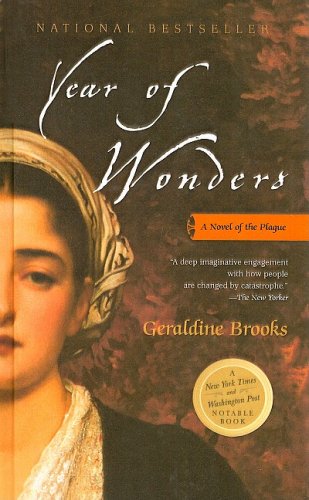
Year of Wonders by Geraldine Brooks

I came at reading Geraldine Brooks in rather a backwards fashion. I started with March, followed by People of the Book and am only now getting to Year of Wonders, Brooks’ first novel. The friend who recommended it described the story as “a book about the plague with some romance thrown in.” With that description in mind, I expected more romance than delivered. Not that less romance is a bad thing, I was just surprised at the outcome of the story.


Backing up, the plot of Year of Wonders revolves around a small northern English town that isolates itself during an outbreak of the Plague to avoid spreading it to neighboring communities. As surprising as it sounds, the story emerged from an actual historical account of an early modern town which did exactly that. The protagonist of the story is the rector’s housekeeper, Anna Frith. The reader learns in the first few pages that she and the rector, Michael Mompellion, are two of the survivors of the attack who remain in the, physically and emotionally, diminished village. Most of the story backtracks and follows the characters through the year of disease, eventually coming full circle so the story meets where it left off at the beginning.


In the Afterward Brooks describes her transition from journalist to novelist, fascinated by understanding the story of the historical Derbyshire village. Brooks’ research skills shine through as her descriptions of the lifestyle and times are apt. At times her graphic imagery leaves too little to the imagination, but given the subject matter it is not surprising. Brooks does acknowledge her choice of a strong female character who sits outside the bounds of traditional society as her focus. In Brooks’ mind the story needed someone who could break the confines of social norms and was in an ability to do so.


I could see common interests in Brooks’ three novels; her work focuses on strong female leads. She takes these characters and places them in nearly impossible (yet historically real) situations to unearth how their strengths allow them to persevere. I enjoy her plots but mostly her development of the issue of integrity.


Year of Wonders reminded me of reading Connie Willis’ The Doomsday Book. The comparison is obvious considering they both focus on the Plague. But the similarities are not merely that straight forward. Like Brooks, Willis writes about the strength and wherewithal to survive adversity and horrible odds. If you haven’t read Year of Wonders and don’t mind descriptive imagery of the Plague, this is a book worth reading. If you’re not so into the Plague, I would still recommend Geraldine Brooks – one of her other stories may be more palatable.

Saturday, August 21, 2010

The Russian Concubine by Kate Furnivall

I picked up The Russian Concubine at a discount bookstore based purely on the blurb on the back. A story about White Russians living in Junchow, China in 1928 sounded like a great locale and population for a novel. After a grad school classmate wrote a paper about Russians in China I became intrigued by an ex-pat community I had never heard about before. This book fit that niche perfectly making it a great opportunity for a summer read.

The Russian Concubine was good, but it could have been better. I really enjoyed exactly what I had hoped for - the locale and the interaction between vastly different communities of inhabitants. However, Furnivall fell into too much romance and the plot fell flat by the end of the story. The story revolves around Lydia Ivanova, a young Russian whose father was killed by the Communists when they were fleeing Russia in 1917. The story picks up in 1928 with Lydia pickpocketing a British gentleman and bringing the money back to her drunken, beautiful, classical piano playing mother. Finding herself trapped by dangerous locals, an exotic stranger saves her - enter the love interest: Chang An Lo.

Furnivall's strength lies in her ability to describe the interaction between the various ethnic communities living in China in the interwar era. The British have the money and the power. The Chinese are in the midst of a Civil War between Chang Kai Shek - supported by the British, and the Communists (pre-Mao and a strong leadership). The Russians, meanwhile, exist in a vacuum without either passports, wealth, or power. Lydia and her mother work to give themselves a legitimacy in the society to which they do not belong. The mother uses her beauty to gain financial and social support from better-off men, the daughter uses her wits to manipulate the society to help her.

While I immersed myself in Furnivall's world the story drug in the second half. She spent too much time laboring over the romantic relationship between Lydia and Chang An Lo. Lydia manages to find and save her love in a highly unrealistic way. At the last moment Furnivall throws in a curve ball which I found highly unnecessary and likewise unlikely.

The Russian Concubine was a good summer read; it was diverting and romantic. But I had hopes of reading a more historically-driven accurate story which it was not.

Friday, July 23, 2010

Every Last One by Anna Quindlen

Anna Quindlen is my hero. She has an incredible ability to vividly yet succinctly describe a scene. Reading her prose is effortless; I never feel like I am wading through unnecessary text, yet I can perfectly envision the world she narrates. Honestly, I have read almost none of Quindlen's more well-known column writing, but I have read every novel she has written so I couldn't wait to get my hands on Every Last One. I finished it yesterday and sat thinking, "Wow."

If you have never read any of Quindlen's fiction, be forewarned. Her books are heavy! And emotional. I cry more reading her than almost any other author. Yet, I respect the dilemmas Quindlen forces her characters to face much more than other author's emotive problem-driven plots (think Jodi Picoult). For me, Quindlen doesn't force a particular emotional response on her readers. Her characters are flawed and human rather than idealistic or purely bad. She doesn't tell a reader how they should respond to a situation; instead she presents the situation and allows the reader to decide how they feel about what happened. Moreover, Quindlen doesn't give away the plot on the dust jacket. I will say, the crisis in Every Last One caught me off-guard. I was completely blind-sided by the events that unfolded in the story. At 3 am I lay in bed sobbing with the main character.

Without giving away too much of the plot, the story of Every Last One revolves around a normal all-American family: a doctor father, a part-time working mother, a 17-year old daughter thinking about college, and twin 15-year old brothers one who plays soccer and the other who plays the drums. The daughter breaks up with her long-term boyfriend, the drum-playing son suffers from depression, the mom ponders her childrens' futures. The reality of Quindlen's characters is what gives her book power. We can all imagine ourselves or our neighbors in Quindlen's fictional family. The realism is what gives the tragedy even greater weight.

I would not recommend reading Every Last One at the beach, or anywhere else in public. But I strongly recommend reading it. It really makes you think.

Thursday, July 15, 2010

Prep by Curtis Sittenfeld

Prep satisfied everything that the last two books I read have not satisfied. I thoroughly enjoyed reading it, even if it wasn't exactly what I thought it would be.


My husband noticed me reading a new book the other night and asked what I was reading. Based on the quotes on the cover I replied, "A female version of A Separate Peace.” My answer was largely tongue-in-cheek but having finished the book, it was actually an extremely apt description. Prep is the story of a fish-out-of-water and her four year experience at an elite East Coast boarding school. From the first day Lee Fiora does not match the stereotypical description of a boarding school student of which she is hyper aware. Throughout the novel her comfort level waxes and wanes and she makes friends, learns to navigate academics, and explores sexual relationships. I think there is something of Lee in every girl.


So many of the conundrums Sittenfeld places on Lee resonate with modern teenagers - whether in boarding school or at home. As I read I found myself personally relating to the angst Lee felt. But I also found myself reflecting on my friends as we traversed the high school issues. One friend in particular suffered from so many of the self-doubting characteristics of the main character that I felt as though I were in her head and I began to understand her better.


I had friends who went to boarding school and while some of the challenges were undeniably unique, I don't think this book speaks exclusively to that audience. I found myself thinking back to college classmates who had gone to boarding school and middle school friends who chose boarding school. In some ways they always seemed a world apart; they had an experience to which I could hardly relate. Yet, I found myself thinking about the intense dynamics of dorm life - even if Lee suggested college dorms were quite different from high school ones. And if nothing else I have read a distinct canon of boarding school literature which addresses similar themes across the ages.


I loved this book as much as I disliked The Secret History. To some that may seem antithetical - after all they are both "academic/literary fiction" - situated in the insular worlds of rich East Coast academia. So I think it only fair to explain the differences in my mind. Neither book is particularly plot driven. Yet I found this one so much more engaging because it was about the development of a teenage girl on an individual and extremely personal level. Interestingly, in the Reader’s Guide Sittenfeld says,

I consider plot above everything else except character. There’s nothing I hate more than some book that’s all just exquisite language. That’s so boring….I very consciously think about plot and say, I want there to be a twist here or I want there to be a surprise.

To me that is indicative of the difference in the two novels. Moreover, Sittenfeld felt like a real person in her interview whereas Tartt annoyed me in hers.


The other main difference between the two stories was the characters. I could empathize with Lee’s plight and I could understand her angst. She was flawed and at times annoying, but generally I would describe her as a character I enjoyed reading. Tartt’s characters were so flawed as to be unlikable.


I read Prep in less than 48 hours. It was a book I thought about and couldn’t wait to pick up again. Now that I’m done I still find myself think about Aspeth and Dede and Martha. I am curious how these individuals lived and worked together. More than anything longevity of thought is a sign of a great book.

Thursday, July 8, 2010

The Shipping News by Annie Proulx

I don't appear to be genetically created to appreciate literary award winners. The Shipping News won the Pulitzer prize after all and yet I found it... boring, honestly. Okay, I am glad that I read it now that I'm done. But it was not a book I enjoyed reading. I can understand why it was award winning when it comes to novelty of style and setting the stage for the plot. But the plot itself is just not very interesting.

The story of The Shipping News revolves around a single father, Quoyle, who finding himself at loose ends moves with his aunt and his two young daughters to a small village in Newfoundland. Although he has never been there before his family is from there and still owns property in the area. Quoyle is an accidental journalist who becomes involved in the town's life while writing the news of the boats coming in and out of port.

Proulx has a unique writing style. At least half of her sentences are fragments. They evoke distinct imagery and the purpose of her style is clear. Yet if 90% of writers tried to emulate Proulx's writing they would be kicked out of school for poor use of language. While I appreciate the idea behind her voice I personally did not find it engaging to read. As a book lover I found it discouraging that every five pages I was more inclined to set the book down and find something else to do rather than keep reading. Last night I had to force myself to focus just to get through the final 30 pages of the story. It is rare that I am that unengaged in a book. Once again I am guessing I am alone in my views on this book. Friends raved about it and gave it to me encouragingly. Other reviews I have seen give it an overwhelming thumbs up. Maybe I just need to realize that I don't appreciate "novelty" and "literary qualities" in my book reading.

I am glad I read The Shipping News. I gave it points for uniqueness and novelty of voice. But the story itself just never caught my attention. To me plot overrides writing style. What can I say, I guess I'm just an action-oriented girl.

Sunday, June 27, 2010

Unaccustomed Earth by Jhumpa Lahiri

If I have a passion for an odd sub-genre of books, it is stories about foreigners adapting to a new culture. I love books like A Suitable Boy by Vikram Seth - books that delve into questions of identity and ethnicity and interacting as a minority. Over the years I have found myself searching out books whose plots revolve around the individual struggles of people in flux. It was an interest in this type of story that brought me to Jhumpa Lahiri in the first place. I read The Namesake and then I saw the movie. The book was better (isn't it always) but the movie was actually quite good.

I have been coveting Unaccustomed Earth for absolutely months and finally got a copy from the library. I devoured the stories in a couple of days. While I loved the book I would have liked a novel better than short stories - but that's just me. I like the development of a novel-length plot. In Unaccustomed Earth Lahiri writes about Bengali-Americans who all interact with their families and deal with their joint cultural identities as integral definitions of their self. I had two favorite stories. One dealt with three post-grad roommates with little in common other than their shared apartment. The Indian girl gets regular calls from Indian men proposing a meet-up for the possibility of a future marriage. But she is heavily involved in a less than healthy relationship. Her American doctoral candidate roommate gets unwittingly involved in her affairs.

The best of the book in my opinion (which plays to my preference for longer stories) is the three-part novella style "Hema and Kaushik." The story unfolds in three parts, each part being narrated by either Hema or Kaushik. These two individuals have a shared family background. Over time their paths cross again and they find their heritage and future life choices brings them together in a way they would not have anticipated.

Lahiri's stories are poignant. While there is something about her characters which make them (maybe) uniquely Indian, she is attuned to universal themes in the relationships between family and friends. Certain aspects reminded me of filial duties I have had friends of mine express in the past. I believe Lahiri is becoming an Amy Tan for the 21st century: a voice for "her people." I would be curious to read more about how she feels about this role because while there is a universality to her stories each of the characters are fiercely unique and independent and not easily categorized by his/her ethnicity and/or identity.

I will happily read more of Lahiri's work. I have not yet read Interpreter of Maladies - a heavily lauded compilation of short stories (heck, it won the Pulitzer Prize) only because I don't gravitate towards short stories. But I have no doubt I will in the future.

Thursday, May 27, 2010

Belong to Me by Marisa de los Santos

I am not a poet. In general I'm not even a fan of poetry. Yet Marisa de los Santos, who is a poet, uses incredible poetry in her descriptive novel. In fact, she breaks most of the rules writing guides tell struggling authors: she uses too many adverbs, she uses cliches with aplomb, and she lets her characters ramble. But put all her idiosyncrasies together and de los Santos writes a very compelling story. What makes the writing work is that each character has his/her own distinct voice.
Cornelia likes cliches and wandering thoughts.
Dev likes logic until logic no longer works.
Piper likes order until order falls apart.

Call me a book snob, but I am not a huge fan of "women's literature." Too many stories revolve around marital problems and children's health. I find them redundant and the authors often work too hard to pull at my emotional strings. Belong to Me does have some of those characteristics and yet I did not find them overwhelming the plot. The story stands strong even without the marital problems and the children's health issues.

Maria de los Santos has the rare skill to write from the perspective of very different individuals convincingly. To tell the story from the perspective of two women who hate one another on sight and yet grow to become friends is a challenge. As a reader my immediate opinion of Piper was disdain and yet by the end of the novel she had redeemed herself through her experiences and her growing acceptance of Cornelia and different ways of seeing the world. De los Santos writes Piper's haughtiness and changing nature realistically.

One of the best aspects of the book was the surprise. I didn't see it coming at all. The author does a great job laying out all the clues buy not alluding to the idea that the information is clues until the reader is hit with what is really going on.

On the other hand, she did wrap things up a bit too neatly for my tastes. In the epilogue she alludes to problems and discord but yet everything is tied up with a neat little bow. A little more discord would have rung more true - although who doesn't want to see all the characters happy at the end?

I would consider this book a good summer read: it makes one think, but not too hard. It has conflict and plenty of sadness - it did make me cry, but yet lots of redemption too.


Wednesday, May 19, 2010

The Help by Kathryn Stockett

I feel as though everyone I know and a LOT of people I don't know have read The Help. Everywhere I turn I see raving comments and reviews of this amazing book I simply *have* to read. I will be honest; the more people tell me I must read a book the greater my cynicism scale rises. I find all too often the books that get the most attention are over-sold and good but in no way amazing. (Think of it like the Star Wars trilogy. Everyone told you how amazing the new movies were going to be and you saw tons of ads showing cool special effects shots, but when you actually watched the movies you were necessarily disappointed. There's only so much hype any story can take before it become impossible to live up to its own reputation.)

So, I picked up The Help wanting to enjoy it but wary it would disappoint. By and large, it didn't. I really enjoyed reading Stockett's view of 1960s Mississippi. One thing I noticed off the bat was I had no idea of the plot of this "amazing" story. For all the raving I had heard, not a single person had explained the basic plot. I had a light bulb moment of realizing who "the help" meant.

In my opinion Stockett's greatest skill is creating believable characters. She had a wide variety of personalities, socio-economic backgrounds,and education levels all stuffed into Civil Rights era Jackson, Mississippi and yet I did not feel any of the characters was a stereotyped cardboard cutout. They all had depth and personality which made them feel real. In her short monologue at the back of the book, Stockett talks about her difficulty writing genuine feeling relationships between White- and African-American characters that didn't sound too Gone With the Wind. I think she was successful in creating an honest and sympathetic view of the love that develops between caregivers and those in need of the care. Each woman in the story has a unique story which dictates who she is and why she sees the world as she does. Yet Stockett does not fall into the trap of grouping characters into an "us" and "them" dichotomy. The closest she has to a wooden character is Hilly and that is only because as a reader we never see the world through Hilly's eyes. A wise choice on Stockett's part as I think it would be difficult to write such a staunchly racist character in today's world and make her at all sympathetic.

My favorite storyline probably involved Minnie and Celia because it was one of the most unexpected. I thought I had figured out Celia and Johnny's relationship and was relieved when I hadn't. I liked the story Stockett wrote much better.

The reason I can't give this book my overwhelming praise and stated "by and large" was the historian who I just can't turn off. Having recently read Precious and seen The Blind Side (and moreover read commentaries and critiques of both the books and the movies) I have a growing awareness of the difference in mainstream views of African-American life and more sidelong stories. While Stockett did a "good" job recreating her world, she was careful. She did not show the horrors she could have shown. She played it safe. Her book was written for and is being appreciate by a white, middle-class, safe audience. She is not going to rock any boats with what she wrote. Overwhelmingly her readers can walk away feeling good about themselves without having to question their own personal morality. The Help is almost a sanitized version of The Color Purple or Beloved.

Wednesday, May 12, 2010

Those Who Save Us by Jenna Blum

I am a confirmed bibliophile: I love to read. I absorb books.
I am a European historian: I am trained to ferret out the nuances and recognize there is no *T* truth.
Once in a while my two worlds collide. The book Those Who Save Us spoke to both of my personalities and at times they argued, at odds about the power and appeal of Jenna Blum's book. In this post I will talk about Those Who Save Us as a powerful novel. I wrote a post on my other blog talking about Those Who Save Us as truth-based historical fiction.

Those Who Save Us is the story of a mother and daughter both trying to understand, overcome, and possibly forget about their experiences in World War II Weimar, Germany. Anna, the mother, lived through the War as a young mother doing what she had to to protect her daughter. Trudy, the daughter, is a German historian, who is trying to understand the Germans and how and why they acted as they did during the War. The story jumps back and forth between the lives of the two women - one in the 1940s the other in the 1990s. As the two stories merge, the reader has the omniscience that the two women lack which makes the story tragic because of the characters' inability to speak and explain.

Blum tells a compelling story of love and hate. Self-hatred plays a strong role in the understanding of the two women. As I read, I suddenly understood why the field of psychology and self-analysis blossomed in the thirty years after World War II. Both of these women desperately needed an outside person to absolve them of their individual guilt. The self-immolation is centered around the character of the brutal Obersturmführer who takes Anna as his mistress. Trudy believes the Nazi Officer is her father and hates herself for her heritage. Her field of study becomes a personal psychological attempt to understand her own life and absolve herself for her family's actions.

The finale of the novel is uplifting but Blum does not fall into the Hollywood trap of wrapping everything up into a neat little box. Questions are answered but everyone is not completely forgiven and happy.

Blum has a history working with Steven Spielberg's Shoah Foundation. She has a good working knowledge of the Jewish (and some German) experience during the Holocaust. That comes through clearly in her novel and the reminiscences of the Germans in the story are honest, brutal, and well-written. My angst about the book revolves around her descriptions of average Germans outside of her main character. I find Blum's writing less frustrating than I find her representation of Trudy who as a historian, even 13 years ago in 1997, should have had a more nuanced and "shades of grey" view of the German people. I am a product of my own schooling and my professors did an incredible job of showing the Germans as Ordinary Men NOT Hitler's Willing Executioners. Blum could have used a touch more understanding.

Tuesday, May 4, 2010

Push by Sapphire

(Don't let the cover you fool you. The novel inside is Push. Publishers re-covered it and titled it Precious because the movie was titled Precious rather than Push. The only difference as far as I can tell is this edition includes a reader's guide and a picture of the movie actor.)

I have had Push on hold at the library since February. I finally broke down and bought my own copy this weekend because I really wanted to read it! Once I had the book in hand I read it in two sittings. It's not long but more than that it's a story that needs to be read continuously. It would be a difficult book to put down after reading only a page or two at a time.

I would be hard pressed to say I *enjoyed* reading Push. The story is far from enjoyable - the plot revolves around a 16 year old girl who is pregnant for the second time by her father who has repeatedly raped her. Her mother beats her upon discovering Precious' first pregnancy at the age of 12 for "stealing her man." It's a sad look at life in contemporary Harlem. However, I am very glad I read this book.

I first heard about Push as a suggested book for high school students in an inner-city school. Having finished it, I can understand the logic behind choosing this book. For many contemporary students, the issues Precious deals with are more true-to-life than what Huck Finn encounters (sadly). I am torn as an educator however. Sapphire writes the book from the perspective of an illiterate teen: the spelling and grammar is non-existent. In an English class, while I can appreciate the use of slang and dialect, I would never want to give students the message that writing so poorly is a good way to get a book published. I would still want my students to write correctly. I do think it would be interesting to pair Push with a classroom study of the Harlem Renaissance. Precious lives on Lenox Avenue and talks about Langston Hughes. Using the book as a commentary on what has or has not changed in African-American society might be really relevant.

As an aside, the style of the book reminded me of Daniel Keye's classic story Flowers for Algernon. Like Charlie, Precious's dialogue, writing, and ability to express herself grow throughout the novel, showing the impact of her new education.

All in all, not a light beach read by any stretch of the imagination. But a worthy story that deserves to be told.

* * * * * * *

Adding a final note. I watched The Blind Side this evening and really enjoyed it. Curious about the accuracy of the film, I started researching it online. I ended up reading an article talking about why The Blind Side has been a better-received film than Precious: an interesting discussion about social perceptions and presentations of young African Americans in mainstream media. But, to the point, I found an NPR article about Sapphire I wanted to share. At the very least I feel like my impressions of the writing are justified knowing Sapphire has an MFA and is versed in American literary traditions.

Monday, April 26, 2010

A Thousand Acres by Jane Smiley

I have picked up A Thousand Acres a dozen times, read the back cover, and put the book back on my shelf. Last week for whatever reason when I picked it up again I didn't put it down. I committed myself to reading Smiley's work. I have read Moo and adored it. But life on a rural Iowa farm didn't jump out at me as an engaging locale for a novel (maybe that makes me a snob, I don't know). Was I going to read about them watching the corn grow?

I am SOOOO glad I read A Thousand Acres. It is amazing. A bit dire, maybe, but honest. Around page 150 I realized that all of my cousins needed to read this book. I began to understand my father's upbringing as the son of a patriarchal farmer father. The characters either chafe at the opportunity to prove themselves to the patriarch or they kowtow to his dominant personality and push all their emotional turmoil further down. Whether Iowa or points east, Smiley created an incredibly realistic (yet not at ALL boring) view of farming life.

Around page 250 I reassessed my statement. I still think the overall premise is extremely relevant for anyone with farming ancestors as the family dynamics are genuine. However, I would not want anyone to associate my grandfather too closely with Larry Cook. Demanding, expecting excessive control over his family and his world: yes. Going as far as Larry Cook: I sincerely hope not.

The series of events which continue to build felt oppressive at times but I understood why Smiley kept laying on the destruction. The characters had ignored so much negativity for so long that when the truth came to light everyone recoiled and fell apart. I just discovered that the plot is a modern, rural retelling of Shakespeare's King Lear which could account for the perpetual destructive tendencies of the characters.

One particular aspect which was a small side plot intrigued me. A Thousand Acres was first published in 1991. When Jess Clark returns he has grandiose ideas of farming his inheritance organically. Because of the focus on organic today I enjoyed reading how traditional farmers perceived the idea of organic in the late-1970s (the periodization of the book). Not only did they think Jess was crazy to suggest such a thing, they also dismissed his ideas about chemical run-off in wells affecting pregnancies. Smiley obviously had an "early" and relevant interest in the debates about modern farming.

When all is said and done, I am glad I finally opened A Thousand Acres rather than sidelining it yet again. Five years ago I probably would not have liked the novel very well. But the time and place I'm in right now, it spoke to me.

Saturday, April 24, 2010

Heart and Soul by Maeve Binchy

Once upon a time, I read every book Maeve Binchy had written. I recommended her books to a friends on the premise that her plots are "innocent." The friend in question read one book and informed me I was insane. She wondered how I could describe books whose plots revolved around abortion, affairs, and love lost could be described as innocent. I stand by my stance. While the characters very often fall under the spell of poor romantic choices, the outcome includes the antagonist getting his (or her, although it is quite often a man) just desserts and the protagonist feeling vindicated.

Heart and Soul is Binchy's most recent work and not only are the protagonists rewarded for their innate goodness, Binchy has gone back to previous books and brought in characters from many past novels and caught the reader up on their lives. Individuals from Quentins, Scarlet Feather, and Whitethorn Woods, among others, all meet through the experiences of the employees of a Dublin heart clinic.

Binchy does a great job of telling a remarkably comprehensive story from the viewpoint of at least a half a dozen characters. Each chapter starts with the perspective of a different individual. At times the stories seem only tangentially connected to the main plot; other chapters push forward the success of the heart clinic. By the end of the novel all of the characters have interwoven stories that coalesce into a logical conclusion.

There are very few true antagonists in Heart and Soul - a racist old lady and a womanizing foreigner. The story is undeniably a syrupy romance. All of the characters who deserve to find love do. After the last couple of dark books I have read recently Maeve Binchy's Heart and Soul was a breath of fresh air - and it is very innocent.

Wednesday, April 21, 2010

Sleep Pale Sister by Joanne Harris

I have sat on this book for about a week without posting about it because I am unsure what I want to say. I liked Joanne Harris' story, but I didn't love it. It read like a dark Victorian-style Gothic with a slight fantastical twist; a novel idea but it seemed to run out of steam.

According to the introduction, Joanne Harris' early novel fell out of production and has only recently been republished as a result of fan demand. Harris made minimal if any changes except for a new cover. She mentions more than once that the book finally has the cover it deserves.

The story in Sleep, Pale Sister revolves around a dysfunctional Victorian couple. Henry Chester, the husband, is a painter who marries Effie, his much younger model. Rather than seeing her as a real person, he sees her as the epitome of the portraits he has painted. She is unworldly, growing up in the narrow confines of her limited experiences, but she yearns for more personal freedom.

The crux of the book centers on the couple's disparate views of personal/sexual interaction. Henry is horrified at the idea of a woman having, much less expressing, sexuality. So much so that the reader learns relatively horrible things Henry has done to other women who do not gel with his ideal stereotype. Effie, needless to say, chafes under his intense scrutiny and eventually revolts in an unexpected way.

The plot was not particularly complex. The outcome was not unexpected, but also not a happy ending. What I liked about Sleep Pale Sister was the study of taking Victorian mores to their excess. Discussions of hysteria and the use of laudanum to control emotionally "weak" women rang true to the era. It took the historic issue of female sensibilities and pseudoscientific means of dealing with them and personalized it.

But, the book felt sophomoric. Harris' other works are so much better: more developed and more nuanced. I maybe wouldn't use that description if I didn't know the book was a reprint of one of her earlier works but knowing it is, I can see the difference. I'm glad I read Sleep Pale Sister, but I don't know if I would have liked the book if I hadn't read other works by Joanne Harris before.

Thursday, April 1, 2010

Prayers for Sale by Sandra Dallas

At some point I decided I wanted to learn to quilt. My mom and I joined a group of retirees who quilted together on Wednesdays, making one quilt a year. They agreed to teach us the basics. One quilt square later I put the quilting down but picked up an appreciation for the difficulty of careful piecing. During our conversations one of the women mentioned the book The Persian Pickle Club, a novel whose central theme is quilting. Both my mom and I read it, thankful to our indirect introduction to Sandra Dallas’ works. Since then neither of us have become master quilters, but we have both read all of Sandra Dallas’ books. Prayers for Sale could be one of my favorites (or Tallgrass… or maybe The Persian Pickle Club), although I would not have said as much until nearly the end of the book.

Dallas has a very specific audience for her novels; most of them deal with the history of the American West and/or Midwest, often Colorado. And quilting usually plays some role in the story. Prayers for Sale is not an exception. The story revolves around two women living in a small mining town in Depression-era Colorado. To be honest, the subject did not appeal to me overmuch (yes I’m a historian but I have always found Colorado history to be booooring). When I read the acknowledgements at the beginning I was not won over either. It appeared that the book was a series of short stories woven together to tell a larger plot. If not done well, woven together stories can be tedious.

There are certain chapters which I felt were heavy-handed in creating a logic to combine the main narrative and the individual story. From time to time it felt too contrived. However, the end redeemed the whole book. When I am sitting in public transportation trying to keep myself from crying over the conclusion of a story, I consider the book a success. Dallas wove together all the disparate stories in an admittedly convenient way but an overall appealing and reflective way. By the end of the book I appreciated the various stories because they did explain the main character whose role was to be a storyteller to keep the history of the area alive.

My mom (the only other person I know whose read all of Dallas’ books and the one who gives me the books to read) has suggested more than once that Dallas’ novels would be effective in a history classroom. She is successful at weaving together accurate historical detail with sympathetic literary characters. While I don’t know many teachers who would take the time to let students explore the stories in a novel, I can see a very genuine place for Dallas’ works – it would engage students who find the standard lecture/note history class unappealing. And it might introduce a whole new generation to both storytelling and quilting.

All in all, a book I am very glad I read.