Monday, November 15, 2010
Sepulchre by Kate Mosse
Wednesday, November 3, 2010
The Mapping of Love and Death by Jacqueline Winspear
I have loved the Maisie Dobbs series since I read the first book. I was thrilled to realize I had an unread book in the series on my shelf: don’t know how I could have missed that earlier. I have heard people call the series “light” because they are mysteries, but really I think there is an incredibly depth to Winspear’s writing. She takes on topics that are weighty and in no way fluffy. She also has created an incredibly real, detailed world which is eminently believable. Winspear is not cozy mystery machine who churns out a new book every season. There is an analytical depth and research background which undermines the descriptions of a mystery as “light.”
In the latest Maisie Dobbs book, Winspear introduces Americans. The soldier who has been killed is an American cartographer who joined the War because he had unique skills and his father was British. Like all Maisie Dobbs books, the plot is more intricate than first perceived.
This book would be terribly hard to pick up without foreknowledge of the series. By the seventh book in the series, Winspear assumers her readers are up-to-date on Dobb’s friends, relationships, and past. This story brings back Maurice, her mentor who has been a foundation of the series. It also reintroduces James Compton and adds a heretofore untold back story which fleshes out the world of Maisie Dobbs. Winspear does an amazing job of combining the mystery and the personal story in a balanced way. She does not go too far astray on either side, losing track of one plotline of the other.
When all is said and done however, I didn’t like this book quite as well as others in the series. The only problem for me was the way the mystery wrapped up. There were too many moments when Maisie knew information which Winspear did not share with the reader. And the denouement was muddy. One character was “sort of” guilty, but I did not feel it was explained as well as it could have been.
Despite the shortcomings, I would wholeheartedly recommend the series. It is easy to get lost in Jacqueline Winspear’s world. And I always learn something new.
Monday, November 1, 2010
Death Swatch by Laura Childs
I have read most of Laura Childs’ books in all three of her series. Death Swatch is the sixth book in the scrapbooking series. And as much as I enjoy Childs’ series I am beginning to feel as though she is spread too thin. For the first time I found inconsistencies and problems in this story.
Laura Childs excels at light cozies with strong female characters. She chooses locales with personality and depth. Her themes – scrapbooking, tea, cooking – all offer great opportunities for creativity and useful tips at the back of the book. In Death Swatch Childs combines Mardi Gras and paper stamping techniques.
But…
She is not a historian. Within one chapter she confuses the era of Jean Lafitte badly. She talks about the 18th century, then she says he lived “over 100 years ago” and then she makes some other claim about the Battle of New Orleans in the early nineteenth century. It was more than a slight editing gaffe. For me it was a sign of someone who is over-extended and not reading or researching as carefully. Aside from flummoxing her dates, she clearly was not overly familiar with the timeline she was writing about. This plot just went too far off the scale to be even remote believable. I realize cozies are not about accuracy and believability, but the authors usually fact check and try to keep their plots vaguely realistic.
All in all, not one of Childs best efforts.
Tuesday, September 28, 2010
State of the Onion by Julie Hyzy
Wednesday, September 15, 2010
The Girl Who Played with Fire AND The Girl Who Kicked the Hornet's Nest by Stieg Larsson
Tuesday, September 7, 2010
The Girl with the Dragon Tattoo by Stieg Larsson
The Girl With a Dragon Tattoo is an international phenomenon. I have to believe everyone in the literate world has heard about this book in the past six months. My mom has read the series, my husband has read the series, friends have read the series. I finally decided I would bite the bullet and read The Girl with the Dragon Tattoo. Too many recommendations tend to leave me cold; I find overwhelming praise often means I am disappointed in a book so I started reading with considerable trepidation.
Happily I can report I liked The Girl with the Dragon Tattoo as much as alluded to by other readers. Larsson writes a compelling book. His characters are not archetypes and yet he describes them well enough to make them believable. All things considered, Larsson does not lack for descriptive detail. Reading the second book in the series I find that he overwhelms with detail, but more on that later.
For anyone left who has neither heard of the book nor seen the movie, the plot revolves around a 30-year old mystery surrounding a teenage girl who disappeared from an island without a trace. Mikael Blomkvist, a veteran journalist suffering from professional problems, is brought in to reanalyze the facts and try one last time to discover what happened. Eventually he needs a researcher to help with his search and brings in Lisbeth Salander, the infamous girl with the tattoo. Lisbeth’s back story ultimately becomes the plot of the Larsson trilogy. In this book Blomkvit and Salander solve the immediate mystery. But Larsson sets up the conundrum for the next two books.
So many people have commented on this story that I don’t feel it necessary to once again rehash the merits of Larsson’s story or writing ability. Let me just reiterate a thought I had when I read Camera: the Swedes are a DARK people. The literature that I have read involves sex and brutality in concrete, detailed terms. I have no idea if this is a fair assessment of the population or merely the books which have been translated to English as having a cross-cultural interest. But either way, it is not a book to be read by the faint of heart. Sexual deviance is an assumed narrative in Larsson’s storylines.
As I write, I am halfway through The Girl who Played with Fire. So far, I like the first book better. But I’ve been told I have to finish all three before I can make any conclusive statements.
Friday, August 27, 2010
The Abyssinian Proof by Jenny White
Jenny White's first novel in the Kamil Pasha series, The Sultan's Seal, was far and away one of my favorite books this year. White has the uncanny ability of imparting a ton of knowledge about the Ottoman Empire, a subject of which she is well versed, without lecturing or falling into a litany of facts. The plot remains the most important aspect of the book.
The Abyssinian Proof, White's second entry in the nineteenth-century mystery series, tells a nuanced story of a little-known religious group living in the middle of Ottoman Istanbul. The information White has at hand about this leftover Byzantine Christian sect is fascinating. There was a tenuous moment when the story veered into a mention of Templars and I feared White had fallen into the trap of writing another derivative Christianity gone bad novel, à la Dan Brown. But, she saved herself and didn't go there. Thank goodness.
It is easy to lose oneself in White’s novels. She tells a compelling story with plenty of interesting twists and intrigues to keep me reading. The mystery is not overly straight-forward but she does throw in clues throughout to keep me guessing. However, White is also knows her history. She is not writing about stereotypes and overused characteristics of the Ottoman Empire. Her depth of knowledge allows me to learn relevant, genuine historical information within the scope of a fictional story.
Moreover, White tends to throw in some subtle social commentary about our own world. The intrigue between the Christians, the Muslims, and the Jews; the distrust of differing religious beliefs; the debate over political and cultural power based on ethnicity all ring as remarkably true today as they did 150 years ago. White manages to point out that the Ottoman Muslims were not some evil religious offshoot with nothing but bloodlust in their hearts. Her characters are somewhat universal.
I look to disappear into my books. But I don’t mind learning something along the way. Jenny White is one of the best current authors who allows me to do both of those things at the same time. I will definitely be keeping my eyes open for the third book in the series. (Oh, and I heard a rumor she may attempt to discuss the Armenian Genocide in a future story. That would capture plenty of attention.)
Tuesday, July 13, 2010
Murder in Miniature by Margaret Grace
Wednesday, June 30, 2010
Chasing Vermeer by Blue Balliett
Tuesday, June 15, 2010
Ruby in the Smoke A Sally Lockhart Mystery by Philip Pullman
Sunday, May 16, 2010
Living Dead in Dallas (Sookie Stackhouse #2) by Charlaine Harris
Wednesday, April 7, 2010
Camera by Eva-Marie Liffner
Sunday, March 28, 2010
Murder in the Sentier by Cara Black
Monday, March 15, 2010
Thai Die by Monica Ferris
Thursday, February 18, 2010
Among the Mad by Jacqueline Winspear
- Maisie Dobbs by Jacqueline Winspear - you should really read this series in order to appreciate and understand the characters
- A Very Long Engagement - there are amazing trench scenes if you've ever wondered
- Joyeux Noel
Wednesday, January 13, 2010
The Sultan's Seal by Jenny White
- The Janissary Tree by Jason Goodwin
- The Aimee Leduc mysteries by Cara Black
- The Far Pavilions by M. M. Kaye (not a mystery but a classic British imperial novel)
Sunday, December 20, 2009
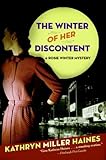
The Winter of Her Disontent by Kathryn Miller Haines
- Jacqueline Winspear's Maisie Dobbs series
- Rhys Bowen's Her Royal Spyness series
- Anything by Anne Perry (she has multiple GREAT series)
Wednesday, December 2, 2009
The False-Hearted Teddy and The Crafty Teddy by John J. Lamb
- The Monica Ferris Needlecraft Mysteries (another craft series)
- The Rita Mae Brown Sneaky Pie Brown Mysteries (another Shenandoah Virginia series)
- Jennifer Chiaverini's Elm Creek Quilt Novels (not mysteries, but about quilting and also take place in nearby Pennsylvania)