Monday, February 22, 2010

Wolf Who Rules by Wen Spencer

Rice Krispie Treats -
undeniably a guilty pleasure.

They remind me of childhood - and grad school if truth be told. But imagine eating an organic rice krispie treat. All the flavor and memories, but none of the guilt (a bit of a stretch maybe, but you get the idea).

Wolf Who Rules is a guiltless guilty pleasure. But the cover makes me feel like I need to hide in shame when I am reading on the train or revert back to my dorky teenage self.

Wen Spencer's first novel in the Tinker series is fabulous. So fun and light and engaging. It is cyber punk meets high fantasy, elves and mechanics, Pittsburgh and Elfhome mixed into one. My husband picked up Tinker at a local bookstore and handed it to me after devouring it in one day. It has taken me 2 1/2 years to get to the sequel.

Wolf Who Rules picks up where Tinker ended. Pittsburgh is stuck on an elf planet, elfs are descending, the evil Oni are ready to invade and Tinker is prepped to save the world. Throw in some romance, some magic, and some high speed chases and you have the story.

There are no deep messages. There is not overriding theme to be discussed in a book group. The purpose of the book is entertainment and Spencer is very good at exactly that. The reason I call this book "guiltless" is Spencer's writing style. She's a good writer who tells a compelling story. I thoroughly enjoyed Wolf Who Rules and wish that Spencer would add more books to the series.

Thursday, February 18, 2010

Among the Mad by Jacqueline Winspear

World War II has long held fascination for Western audiences. Every year countless books and movies appear analyzing obscure facts about World War II history. Hitler and the Holocaust have been done and redone. An intriguing topic, undeniably. However, World War I has long gotten short shrift. If overarching impact on the Western world is the question, I would be hard pressed to state that one war had a greater impact that the other.

In the past five years I have noticed a growing shift. More and more people are writing, watching, and talking about World War I. Jacqueline Winspear's Maisie Dobbs series is an incredible addition to the field of World War I books. While the stories take place in the 1920/30s, each story further develops the impact of the War on the people of Britain. I am continually amazed at how well Winspear examines and understands the mores, expectations, and disappointments of post-War Britons. With each one of her books I feel as though my academic understanding of twentieth-century Europe is deepened by her work.

In Among the Mad, the most recent Maisie Dobbs novel, Winspear tackles psychological repercussions of war and depression in general head-on. I rave about all of her books but this one blew me away. Winspear is remarkably sympathetic to her characters who have all suffered from the War in some way. She brings back topics from earlier books to help demonstrate how unexpected events can return and cause psychological distress years later. The "criminal" in the story suffers from PTSD - although post-traumatic stress was not coined and recognized until generations later - and mental trauma due to World War I nerve gas exposure. Rather than criminalize the criminal, Winspear creates an empathetic character who has found himself in an unforgivable situation. Winspear's outcome brought up another excellent aspect of her books.

While writing about a period seventy years in the past, Winspear addresses very cogent contemporary debates. What role do scientists play in War? Who is responsible for military technology and how should responsibility for destruction at the hands of the war machine be handled? Does society have a responsibility to acknowledge the traumas of soldiers and how can those issues be reconciled? I walked away from Among the Mad pondering any number of current military/political situations. I can't say that is true about many historical or mystery books.

I think there is something for everyone to enjoy in Winspear's novels. She pens a great mystery. She is amazingly historically accurate. She addresses deep questions worth revisiting. A definite two thumbs up.

If you like World War I read:
  • Maisie Dobbs by Jacqueline Winspear - you should really read this series in order to appreciate and understand the characters
and see:


Friday, February 12, 2010

Charlie and the Chocolate Factory by Roald Dahl

There is no denying I'm a bibliophile. So I love the idea of introducing my kids to books. And now that they're getting a little bit older I am anxious to delve into the chapter books I adored as a child - as well as all the great new classics.

Unfortunately, my eldest has not been interested. He complains if there is not a picture on every page. He will listen to two or three chapters and then put a book aside for three months without asking for it. If we suggest returning to the book he complains and picks out a picture book. He's 6, he's justified. It will change eventually.

For Christmas, Eldest got the Roald Dahl box set. I know many of the titles although I never read any of them myself. Last month Eldest picked out Fantastic Mr. Fox - based purely on the fact that he had heard of the movie. He thoroughly enjoyed it, in part because Dahl's books have enough pictures to satisfy him but enough text to tell a real story. After finishing it he told me he no longer needs a picture on every page. He has not yet asked to see the film - which we won't see until he's a bit older. (It was not my favorite story, but I was thrilled to see him getting into a longer book.)

Three days ago he brought me Charlie and the Chocolate Factory. We curled up and read the first two chapters. He liked it. That night dad read chapters 3 and 4. Again, he sat quietly and listened. Over the next couple of days we read the next few chapters.

Yesterday he and I were still stuck inside thanks to the everlasting snowstorm. I suggested he bring his book down. We curled up on the couch and I started reading. We got through chapter 10 and I kept going. In chapter 11 Charlie finds the Golden Ticket. Eldest's legs began to twitch. Then they began to bounce. When Charlie found the ticket Eldest jumped up and gave me a giant hug. "Keep reading, keep reading, keep reading!"

His next questions, "What time do we have to pick up Youngest? Can we read until then?"

At bedtime last night we started Chapter 17. This morning I woke up to Eldest standing over me grinning with Charlie and the Chocolate Factory thrust in my direction.

Thank you Roald Dahl!

Tuesday, February 9, 2010

Passage by Connie Willis

I ADORE Connie Willis' books. She is an amazing writer. I could wax poetic about her incredible ability to juxtapose believable science fiction with incredibly witty humor - and not in the punny Piers Anthony style either. As a rabid er avid fan, I picked up Passage and anxiously started reading.

It's... different.

In so many ways.

I enjoyed Passage but it is truly a strange book.

The book revolves around death. What happens when you die - or nearly die. The main character is a psychologist studying near-death experiences. She begins working with a medical doctor who is medically inducing near-death experiences in order to study how the brain chemically reacts. Both characters hope that by understanding such experiences they will be able to help victims who have cardiac arrest. Willis points out in witty terms that it is NOT a retelling of the move Flatliners.

The plot takes 800 pages to unravel. One person described it as a medical procedural which is accurate as there are moments of plodding scientific experimentation, rejection of ideas, repeated testing and final proof of hypothesis. Willis is unfailing in her ability to prove her ideas convincingly. But for once I wished she had hurried a bit. I felt the story lagged in the middle as the characters ran back and forth reasserting their beliefs and disagreeing with one another about motivations. In the middle of the characters rambling, Willis does introduce a number of memorable characters who are worth getting to know.

After finishing Passage I searched out Willis' website. I figured there had to be some motivation for her to have written the book. In a Locus excerpt, she explained that after her mother died she found grief texts to be horrible and unhelpful for the grieving individual. Her book is an attempt to respond to the lack she found. I'm not convinced she succeeded - it would never occur to me to hand Passage to someone dealing with grief. However, I can imagine how writing the novel helped Willis herself.

In an aside, Willis has an extremely novel take on Alzheimer's patients. She suggests an interesting premise on *where* someone from Alzheimers goes when they lose track of current reality. It is Willis' ability to convincingly create realities like this one that makes me appreciate her books so much. It also made me guess she has personal experience with Alzheimers based on how she wrote.

If you like Connie Willis and haven't read Passage it is worth a read. But do not expect to feel uplifted while reading.

If you liked this book, I would recommend:

Tuesday, January 26, 2010

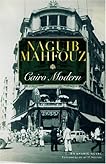
Cairo Modern: an Arabic Novel by Naguib Mahfouz

A number of years ago I happened upon The Cairo Trilogy and fell in love with Naguib Mahfouz and the Egyptian world he created. The series made me want to pick up and move to Cairo - well, the historical Egypt created by Mahfouz at any rate. Mahfouz had an incredible way of introducing readers to the subtleties and intricacies of social and political life in Egypt.

When my mom handed me Cairo Modern I was thrilled to revisit the world of Mahfouz.

A couple of initial thoughts:

Why is this "an Arabic novel"? The subtitle is extremely odd. Is any book about Egypt Arabic? Or is Arabic synonymous for Muslim? Is it only the American edition that adds that subtitle? Why?

What happened to bring this book to the American audience in 2008? Given all of Mahfouz's works, was there something in particular about Cairo Modern that interested American publishers now?

Cairo Modern is not nearly as accessible a story as Mahfouz's Cairo Trilogy. The main character in this story is not sympathetic and hard to engage with. While writing a story about his plight as a university student hampered by poverty is laudable, Mahfouz sets up a protagonist who is unlikable. In addition, for an American audience, the plot is very limited. The story revolves around a very small set of choices and outcomes.

Hmm.. that's not really true, I suppose. But it seems like the story circles on itself and spends significant time reflecting on minute details.

Despite my criticisms and questions, I think Mahfouz's book has a valid role as an academic source. Mahfouz has written a pointed caricature of Egyptian society in the early 1930s. From the story it is clear that Mahfouz finds the social changes occurring in the era to be corrupting and problematic for the Egyptian people - in particular the college educated who are expected to thrive in this bifurcated, confused society.

I think a study of women in Cairo Modern, as in Mahfouz's other novels I have read, would be a worthwhile venture. The new choices for women in the "modern" unveiled world, as described by Mahfouz are in no way laudable. I would argue that Mahfouz would have preferred the "anti-modern" or maybe "a-modern" world of the pre-World War I era.

I am glad I read Cairo Modern. But, I'm glad I read it as a scholar who teaches Middle Eastern History. There are very few people I would recommend this book to (not because it is a bad book AT ALL but because it has an extremely narrow scope), and most of them would be scholars, not fiction lovers.

If you liked Cairo Modern I would recommend:


Friday, January 15, 2010

The People of Sparks by Jeanne DuPrau

I read The Book of Ember this summer and thoroughly enjoyed it. With my Christmas gift card I bought the second book in the series, The People of Sparks (Somehow I find it easier to pay full price for kids books because I know they will get read by multiple members of my family).

I read the book in twenty-four hours. Then I sat down to review it.

I'm torn.

As a reader, I really liked DuPrau's continuation of the Ember series. As a parent, I have trouble with this as a young reader book. I may need to reconsider my definition of "young reader" but I will leave that topic for another post. Suffice it to say, I will not be reading this book to my six-year old son anytime in the next two to three years.

Post-apocalyptic stories have fascinated me since junior high. I am continually intrigued by how an author envisions the future. DuPrau has done a good job: Lina finds a Monopoly game and a magnifying glass, characters use "wagon-trucks" (old trucks with their engines removed) as oxen-pulled vehicles. The world above ground has no electricity, in contrast to the Ember world of the previous book which had electricity but no trees or animals.

The main story in the book revolves around the intersection of these two societies as they try to work together to move forward. However, it is exactly this post-apocalyptic theme that disturbs me given that this is a children's book. I am uncomfortable explaining to my son why a bunch of characters die in the first twenty pages or why war is a recurring theme in the story.

In addition, DuPrau has a limited space to tell her story. She does a good job of continuing to flesh out her characters. She delves into moral questions that are appropriate for a young reader to consider. But, because she is constrained by page count, the book feels very heavy and very dark throughout. DuPrau does not take enough time to stop and smell the flowers, literally. I would have liked a bit more character exploration of this brand-new world full of flowers, trees, birds, and bugs.

Would I recommend this book, yes. But with reservations. Some kids could handle it. Others I think would have trouble reconciling the debates. I could read the book in 24 hours but spending a week or two going through the story it would have felt very heavy.

If you liked The People of Sparks /post-apocalyptic books (and you're an adult) I would recommend:

Wednesday, January 13, 2010

The Sultan's Seal by Jenny White

Wow!! This is one of the most amazing first in a series novels I've read in a long time. The information and accuracy is incredible. Unlike certain unnamed academic authors, White does not fall into the trap of telling information she knows just to prove how smart and knowledgeable she is. Every gleam of detail is necessary to forward her story. Just wow! I'm in love.

Author Jenny White is a professor of Anthropology and has written academically about the Ottoman Empire. Her knowledge of Turkey, the complicated workings of the political system, the debates surrounding nationality and identity, the innerworkings of power in the harem, and the political maneuvering of the European nations all combine to make this a historically accurate but also well-developed murder mystery.

The main character Kamil Pasha is a Turkish magistrate who trained at Cambridge. As such he straddles his familiar Turkish world and the modernizing British scientific method world. He wants to see his country survive and flourish but he does not ascribe to some of the "traditional" organization of Turkey.

The plot revolves around the discovery of a young British woman who is found drowned. She is wearing a locket that ties her to the sultan's palace. Kamil Pasha works with the daughter of the British ambassador to attempt to discover the identity of the woman and learn how and why she was killed. The story is twisted and interwoven. It is not straight-forward and at the end the resolution is not a neatly tied-up package. White leaves a lot of questions to be answered, which I think is more honest than many mystery novels.

After reading the book I found myself thinking about a criminal investigation in such a society. When men have no access to most women how are they expected to investigate the death of a woman? He had to have the assistance of someone who could breech the inner circle.

One review I read suggested the British character was too flippant and well, dumb. I didn't see that. I thought that White painted a stereotypical character for the time. She used Sybil as a representative Brit who wanted to understand Turkish society but could not divorce herself from her Britishness.

There are two very nitpicky things I disliked about the book:
The chapters with Kamil Pasha were in present tense. Personally I prefer reading books written in past tense. But I understand her literary choice as it separated those chapters from the ones written from another character's perspective that were often about past events.

I would have liked one more chapter to wrap up the story. I felt that she ended a touch too quickly. There is the obvious motivation of having the reader pick up book #2. Yet, I still wanted a little resolution. What happened when the sun rose?

All in all, a big thumbs up. If you like historical mysteries and have any interest in the Middle East - an amazing read!

If you liked The Sultan's Seal, try these books: